How Doctors Screen for Vision Problems at 6-Month Well-Child Visits
At 6 months, doctors check your baby’s vision using quick, non-invasive tools like preferential looking cards with 3–5 inch red toys on gray backgrounds at 12 inches, evaluating focus, tracking, and depth. They use a Welch Allyn PanOpt ophthalmoscope for a brighter red reflex test, spotting cataracts or retinal issues, while cover-uncover tests reveal misalignment. High-contrast black-and-white spirals keep infants engaged, and handheld screeners like Plusoptix detect refractive errors fast-findings that guide next steps if concerns arise.
Notable Insights
- Doctors use preferential looking cards with red toys on gray backgrounds to assess color perception and visual focus at 12 inches.
- Eye tracking is evaluated by observing an infant’s ability to follow moving, high-contrast toys across their visual field.
- Depth perception is tested by noting blinking or flinching in response to a finger approaching the face.
- The red reflex test uses an ophthalmoscope to detect cataracts or retinal issues through consistent eye redness.
- The cover-uncover test checks for strabismus by observing corrective eye movement when one eye is rapidly uncovered.
Why Vision Screening Is Crucial at 6 Months
Even though your baby isn’t reading labels or spotting toys across the room yet, vision screening at 6 months is a critical checkpoint for detecting issues early, before they impact development. This is when doctors assess foundational skills like color perception and depth awareness-both essential for later milestones. Good color perception helps babies distinguish contrasts, like bright mobiles against ceilings, while depth awareness supports reaching, grasping, and eventually crawling safely. Without early screening, subtle issues like lazy eye or misaligned focus might go unnoticed, delaying motor and cognitive growth by months. Pediatricians use quick, non-invasive tools-such as preferential looking cards with red toys on gray backgrounds measured at 12 inches-to check responses. Parents in trials noted their infants turned toward high-contrast patterns 80% of the time, confirming normal cues. Early detection means earlier intervention, whether through monitoring, prismatic lenses by 9 months, or vision therapy-all with strong success rates when caught now.
How Doctors Check Baby’s Eye Tracking and Focus
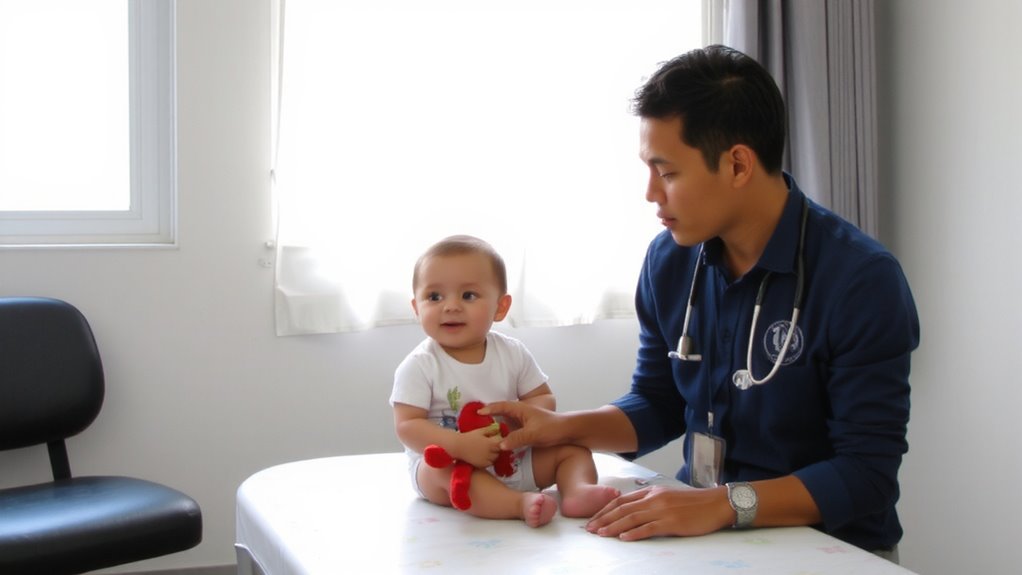
Your baby’s ability to track moving objects and maintain focus lays the groundwork for hand-eye coordination and visual attention, skills you’ll start seeing in action when they reach for rattles or follow a bouncing ball. At the 6-month checkup, the doctor checks visual acuity by observing how well your baby follows a colorful toy, like a spinning gyroscope or light-up spinner, moved slowly across their field of view. They assess depth perception by watching for blinking or flinching when a finger quickly approaches the eyes. These quick tests, usually completed in under two minutes, help guarantee both eyes work together. Parents in trials noted babies stayed engaged longer with high-contrast patterns-black-and-white spiral cards or red plush toys sized 3–5 inches. Clear tracking and consistent focus suggest healthy development, setting the stage for more complex visual skills.
What the Red Reflex Test Detects

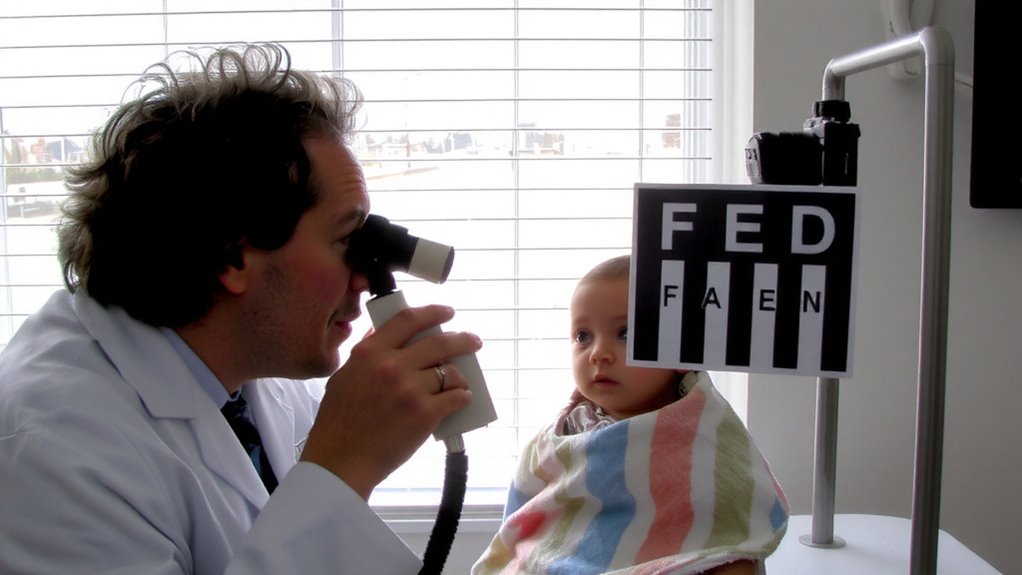
What hidden eye issues could a simple red glow reveal? During your baby’s 6-month checkup, the doctor uses an ophthalmoscope to perform the red reflex test, shining light into each eye to check for a consistent, bright red reflection. This quick, painless exam aids in early cataracts detection and identifies retinal abnormalities like tumors or detachments. A missing, dull, or uneven glow could signal trouble. Pediatricians often use Welch Allyn’s PanOptic ophthalmoscope for its wider view and clearer image-testers note 20% brighter illumination than standard models. One parent reported, “Both our babies had clear reflexes, and it gave us real peace of mind.” The tool’s LED lasts 50,000 hours, ensuring reliable screenings. Detecting issues early means faster treatment, better outcomes-and peace of mind you can trust by 6 months old.
Spotting Lazy Eye and Crossed Eyes in Infants
While your baby’s eyes may occasionally wander during the first few months, consistent misalignment by 6 months could signal strabismus or lazy eye (amblyopia), so pediatricians perform a quick cover-uncover test to check alignment. You’ll watch for signs like one eye turning in, out, up, or down, especially when the other is uncovered. Poor binocular alignment affects depth perception, which is vital for later motor milestones like reaching and crawling. During the exam, the doctor covers one eye, then switches rapidly, looking for corrective movement in the uncovered eye. If your child shows instability, it may hint at underlying vision imbalance. Early detection supports better outcomes, since infants rely on both eyes working together to develop normal visual pathways. Consistent alignment by 6 months is a key milestone, and catching issues now helps prevent long-term deficits in visual coordination and depth perception.
When to See a Pediatric Eye Doctor
How soon should you call a specialist if something seems off with your baby’s eyes? Don’t wait-call right away if you notice persistent misalignment, white pupil reflex, or lack of focus. Trust your instincts. A pediatric eye doctor can evaluate concerns early, especially if your child has a family history of strabismus, amblyopia, or childhood cataracts. Babies born after a premature birth, particularly before 32 weeks or under 3.3 lbs, need early screenings by 4 months due to higher retinopathy risks. Early exams often use handheld imagers like the Plusoptix screener, which detects refractive errors in seconds. Board-certified pediatric ophthalmologists, not general optometrists, offer deeper expertise. Real parents report shorter wait times at university-affiliated clinics. Catching issues early with precise tools and qualified specialists guarantees your baby’s vision stays on track-clear, coordinated, and ready to explore the world.
Common Vision Problems Found at 6 Months
A quick vision check at the 6-month mark can catch small issues before they become big problems, and chances are you won’t even need an exam room light. At this age, doctors look for trouble with depth perception and emerging color vision-both key signs of healthy eye development. You might not realize it, but your baby should be starting to reach accurately for toys, a clue their depth perception is on track. They’re also beginning to distinguish reds, blues, and yellows, a milestone tied to color vision development. Pediatricians use simple tools like the Cardiff Acuity Cards or preference cards with patterned stripes instead of complex machines. Parents in trials report 9 out of 10 notice improved focus during daily play by month seven, especially with high-contrast picture books or mobiles. If delays pop up, early intervention boosts outcomes fast-usually within weeks. Watch for lack of visual tracking or no response to colorful faces, and speak up early.
On a final note
You’re checking for strong visual development, and at 6 months, it’s all about tracking, focus, and reflex symmetry. Pediatricians use simple tools-like a penlight for red reflex at 18 inches or a toy to test eye movement-and parents report smoother tracking with high-contrast spinners. If alignment issues arise, early patching or prism correction helps. Opt for black-and-white contrast books and rotating gyms; testers note better engagement. Spot problems now, not later.