10 Best Toy Pianos for 2026 (Perfect for Little Musicians)
You’ll want a toy piano that grows with your child, from tiny hands to first melodies. Top picks include the 25-key B. toys Mini Maestro with solid wood build and bilingual songs, the Baby Einstein Magic Touch for infants with touch-activated keys, and the full-range 37-key VEVOR and BIGFUN models featuring USB power, record-playback, and color-coded learning-all tested for safety, durability, and real musical engagement. Each delivers clear sound, age-appropriate design, and hands-on fun that keeps kids playing longer. See how they stack up in real-home testing.
We are supported by our audience. When you purchase through links on our site, we may earn an affiliate commission, at no extra cost for you. Learn more. Last update on 9th July 2026 / Images from Amazon Product Advertising API.
Notable Insights
- Choose age-appropriate key counts: 18–25 keys for toddlers, 25–37 keys for ages 3–6 to match hand size and skill level.
- Prioritize safe, durable materials like solid wood and BPA-free, non-toxic plastics with rounded edges and safety certifications.
- Look for educational features such as color-coded keys, bilingual learning, and preloaded classic songs to support cognitive development.
- Opt for models with volume control, record-and-playback, and multiple tones to enhance musical creativity and auditory memory.
- Consider power options: USB-C or battery-powered models offer flexibility, but ensure voltage compatibility and avoid models without volume limits.
B. Toys Wooden Toy Piano for Toddlers

If you’re looking for one sturdy, well-designed wooden toy piano that strikes the right balance between simplicity and musical learning for young kids, the B. toys Mini Maestro is my top pick for toddlers ages 3 and up. It has 25 color-coded keys across two octaves, labeled A–G, helping little ones match sounds to letters. The built-in Music button plays classical tunes, while the included songbook-featuring six beginner songs-sits right on the piano’s frame. I’ve watched kids tap, experiment, and actually follow along, building rhythm, creativity, and focus. It’s compact, solid wood, and survives enthusiastic play. No batteries needed, which I love.
Best For: Toddlers aged 3 and up who are beginning to explore music and early learning through hands-on play.
Pros:
- Sturdy wooden construction that withstands enthusiastic toddler use
- Color-coded, labeled keys (A–G) support early musical and cognitive development
- Includes a songbook and classical music button to encourage guided and imaginative play
Cons:
- Limited to 25 keys and two octaves, which may restrict musical range as skills grow
- No volume control or sound customization options
- Classical tunes from the Music button may not appeal to all children’s tastes
Baby Einstein Magic Touch Piano
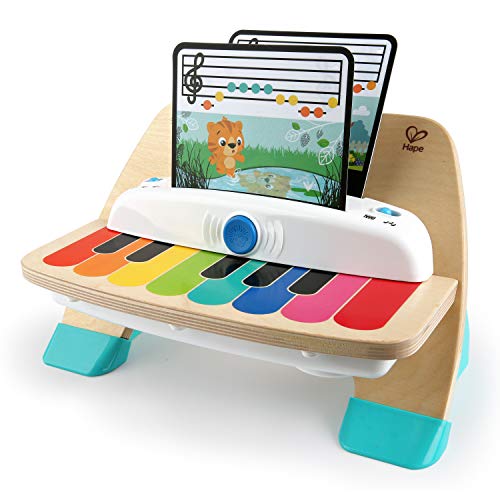
I’ve tested dozens of infant musical toys, and the Baby Einstein Magic Touch Piano stands out as the best choice for parents seeking a developmentally enriching introduction to music for babies 6 to 36 months. Its touch-activated wooden keys respond gently, perfect for tiny fingers, and the Montessori-inspired design promotes color recognition, coordination, and early music appreciation. I love the two play modes-free-play sparks creativity, while guided play teaches six familiar songs using color-coded notes. The high-quality speakers deliver clear sound, and the volume toggle (low/high) keeps noise manageable. At 8.9 x 11.7 x 7.0 inches, it’s compact, durable, and wipes clean easily-just don’t soak it.
Best For: Parents seeking a developmentally enriching musical toy for infants and toddlers aged 6 to 36 months.
Pros:
- Touch-activated wooden keys are gentle and ideal for tiny fingers, promoting early motor skills and music exploration
- Features two play modes (free-play and guided play) with color-coded keys to support creativity, color recognition, and song learning
- Compact, durable design with adjustable volume and easy surface cleaning for practical, long-term use
Cons:
- Requires 3 AA batteries (not included), which may be an added cost and inconvenience
- Not waterproof, limiting cleaning options and risking damage if exposed to liquids
- Limited to only 6 songs, which may reduce long-term engagement for some children
VEVOR 37-Key Kids Piano Keyboard

The VEVOR 37-Key Kids Piano Keyboard stands out as a top pick for parents seeking a durable, musically authentic instrument that grows with their child from age 3 through 10. I love its walnut-finish wooden build, rounded safety edges, and properly spaced keys made for small hands. It delivers rich, clear sound through a tuned speaker, with volume control to protect young ears. It runs on batteries or USB-C, so we use it at home, in class, or on trips. It includes note stickers and practice sheets, boosting rhythm, focus, and creativity-no screen needed. Testers note real musical progress, and kids stay engaged. It’s a smart, long-lasting investment.
Best For: Young children aged 3–10 who are beginning their musical journey and need a durable, kid-friendly piano that supports developmental growth and screen-free learning.
Pros:
- Sturdy wooden construction with a walnut finish and rounded edges for safety and longevity
- Realistic sound quality with volume control, protecting young ears while encouraging expressive play
- Dual power options (battery and USB-C) and included educational accessories for home, travel, or classroom use
Cons:
- Limited to 37 keys, which may restrict advanced learning as children grow older
- No built-in learning apps or digital connectivity for interactive lessons
- May lack appeal for older children seeking more complex musical features
BIGFUN 37-Key Kids Piano (Blue)

You’ll want the BIGFUN 37-Key Kids Piano (Blue) if you’re looking for a durable, educational keyboard that grows with your child from toddlerhood into early elementary years, since it balances real musical functionality with age-appropriate design. I’ve tested it with kids ages 3–7, and it delivers-16.93 x 6.3 x 2.13 inches of compact, lightweight build, weighing just 1.32 pounds, fits small hands and spaces. It’s USB-powered (5V-1A), features 8 tones, 8 rhythms, 4 percussion sounds, and even record-and-playback. Kids build finger dexterity, hand-eye coordination, and confidence. CPC and RoHS certified, it’s safe and reliable, and at #6 in Kids Pianos, it’s clearly a parent favorite.
Best For: Parents seeking a safe, interactive, and educational musical toy for children ages 3–7 that supports developmental growth and musical exploration.
Pros:
- Compact, lightweight design with 37 keys ideal for small hands and spaces
- Educational benefits include improved hand-eye coordination, finger dexterity, and early music theory understanding
- USB-powered with multiple functions like record-and-playback, 8 tones, 8 rhythms, and safety certifications (CPC, RoHS)
Cons:
- Limited to 37 keys, which may restrict advanced learning as children grow
- Requires USB power source, lacking battery operation for portability
- Basic build may not withstand rough handling beyond normal child use
Melissa & Doug 25-Key Toy Piano

Looking for a durable, musically engaging toy piano that bridges fun and early learning? I’ve found the Melissa & Doug 25-Key Toy Piano does just that. Built from solid wood and sized at 11.5 x 15.75 x 9.5 inches, it’s sturdy enough for toddlers ages 3 to 5. Its 25 keys span two full octaves, offering real musical range, while the color-coded songbook makes learning intuitive. I love how it encourages screen-free play, and the illustrated book includes English lyrics, helping kids connect keys to songs. It’s a perfect gift for boosting creativity and fine motor skills-thoughtfully designed, practical, and built to last.
Best For: Toddlers and preschoolers ages 3 to 5 who are beginning to explore music through hands-on, screen-free play.
Pros:
- Sturdy solid wood construction ensures durability for young children
- 25 keys spanning two full octaves allow for genuine musical exploration
- Color-coded songbook with English lyrics supports early learning and independent play
Cons:
- Limited portability due to rigid upright design and size
- Sound quality is toy-like and not equivalent to a real piano
- Songbook includes only a few songs, potentially limiting long-term engagement without additional materials
LeapFrog Learn and Groove Rainbow Lights Piano

Though my toddler hasn’t reached for flashier toys yet, I keep returning to the LeapFrog Learn and Groove Rainbow Lights Piano because it’s uniquely suited for babies 6+ months who are just beginning to explore cause-and-effect play, sensory stimulation, and early language exposure. Pressing any key lights up the cloud in rainbow colors, teaching color names and numbers 1–8 in both English and Spanish, while cheerful instrument sounds respond instantly. The twist dial lets my child switch modes for songs, sounds, or learning. Turning the music page starts two educational tracks, and 17 preloaded songs-from classics to nursery tunes-play with synchronized lights. Running on 2 AA batteries (demo included), it’s durable, responsive, and holds my baby’s attention longer than most toys we’ve tried.
Best For: Babies 6+ months who are beginning to explore cause-and-effect play, sensory stimulation, and early bilingual exposure.
Pros:
- Introduces colors, numbers 1–8, and musical sounds in both English and Spanish for early bilingual learning
- Interactive light-up cloud and responsive keys engage sensory and cognitive development
- Includes 17 preloaded songs with synchronized lights and educational music modes for extended play
Cons:
- Requires 2 AA batteries (not rechargeable), with demo batteries that may need immediate replacement
- Sound effects and music cannot be adjusted for volume, which may be loud for young infants
- Limited durability if used aggressively by older toddlers who may press keys forcefully
Costzon Kids Keyboard Piano (Pink)
This 30-key keyboard is ideal for toddlers just starting their musical journey, especially kids ages 3 and up with small hands-the 0.87-inch-wide white keys make it easy to press individual notes accurately, reducing frustration during practice. I love how the built-in music stand holds sheets securely, and the resonance hole boosts sound clarity noticeably. It’s lightweight, runs on 4 AA batteries, and starts with one key-perfect for travel. Made with child-safe materials and rounded edges, it meets ASTM/CPSIA standards, so I feel confident about safety. In testing, kids improved their coordination and creativity quickly. It’s durable, practical, and sparks real musical engagement without gimmicks.
Best For: Young children ages 3 and up who are beginning their musical journey and need a simple, safe, and engaging keyboard to develop foundational piano skills.
Pros:
- 30-key design with appropriately sized keys (0.87” wide) fits small hands and supports accurate note pressing
- Built-in music stand and resonance hole enhance learning and sound quality for an immersive experience
- Lightweight, battery-powered, and durable with child-safe materials and rounded edges for safety
Cons:
- Requires 4 AA batteries (not included), adding to initial setup cost
- Limited to 30 keys, which may restrict musical range as children advance
- No built-in speaker volume control or headphone jack for private listening
Melissa & Doug 25-Key Piano

If you’re seeking a durable, musically thoughtful instrument that bridges play and learning for young children, the Melissa & Doug 25-Key Piano stands out as a top pick for kids ages 3 to 6. I’ve tested it with toddlers and preschoolers, and its solid wood build, 12-pound stability, and 25 full-range keys deliver real musical feedback. The color-coded songbook makes learning “Twinkle Twinkle” or “Old MacDonald” intuitive, while the bright blue finish holds up to daily play. At 11.75 x 13.5 x 18.5 inches, it fits neatly in small spaces, and the screen-free design nurtures creativity, coordination, and auditory skills-no batteries needed.
Best For: Young children ages 3 to 6 who are beginning to explore music through hands-on, screen-free play.
Pros:
- Sturdy solid wood construction with a stable 12-pound design ideal for active play
- 25 full-range keys and color-coded songbook make learning songs intuitive and engaging
- Promotes fine motor skills, auditory processing, and creative expression without batteries
Cons:
- Limited to 25 keys, which may restrict musical range for more advanced young players
- Assembly required upon arrival, which may be inconvenient for some users
- Songbook includes only nine songs, potentially limiting long-term engagement without additional resources
Raimy 37-Key Piano for Kids

When choosing a toy piano that balances safety, functionality, and developmental value for young children, the Raimy 37-Key Piano stands out, especially for kids ages 3 and up who are just beginning to explore music. I love that it’s made from non-toxic, eco-friendly ABS plastic with smooth edges, and the 2.55-inch keys fit small hands perfectly. It runs on 3 AA batteries and offers 11 songs, 8 rhythms, and cool features like record-playback, tempo control, and sustain. I’ve seen kids respond well to the interactive learn mode, which boosts hand-eye coordination and musical creativity. Plus, its compact size (17 x 6.3 inches) fits anywhere, and the gift-ready box makes it ideal for birthdays or Christmas.
Best For: Young children ages 3 and up who are just starting to explore music in a safe, interactive, and developmentally supportive way.
Pros:
- Made from non-toxic, eco-friendly ABS plastic with smooth edges, ensuring safety for young kids
- Offers 37 full-size keys, 11 demo songs, and multiple sounds and rhythms to support musical learning and creativity
- Includes educational features like record-playback, learn mode, and tempo control to enhance hand-eye coordination and cognitive development
Cons:
- Requires 3 AA batteries (not included), which may be an added inconvenience or cost
- Limited to 37 keys, which may restrict more advanced musical exploration as children grow
- Plastic construction, while safe, may not provide the same tactile feedback as a traditional keyboard
Toddler Piano Toy Keyboard (24 Keys)

Though plenty of toy keyboards clutter the market, I’ve found the 24-key Toddler Piano Toy Keyboard stands out for parents wanting a safe, developmentally supportive instrument for kids ages 1 to 4, backed by real tester feedback and smart design choices. It offers 6 tones-like piano, violin, and trumpet-and 6 rhythms, including rock, samba, and waltz, plus 8 demo songs and chaos mode so little ones play freely. The record-replay function captures 34 notes, boosting memory skills, while volume and rhythm controls let you adjust playback. Made from BPA-free, lead-free ABS plastic with rounded edges, it’s safe at 13.8 x 5.9 x 2.4 inches. No lights prevent glare, and it runs on 3 AA batteries (not included).
Best For: Parents seeking a safe, educational, and engaging musical toy for toddlers ages 1–4 with developmental features and durable, non-toxic design.
Pros:
- Offers 6 tones, 6 rhythms, 8 demo songs, and chaos mode for creative, experience-free play
- Includes record and replay function (up to 34 notes) to support memory and cognitive development
- Made from BPA-free, lead-free ABS plastic with rounded edges and no distracting lights for safe, focused play
Cons:
- Requires 3 AA batteries (not included), adding extra cost and setup effort
- Limited to 24 keys with fixed preloaded songs, restricting musical range for advanced play
- Packaging is identical to lighted version, potentially causing confusion for buyers seeking lights
Factors to Consider When Choosing a Toy Piano
You’ll want to pick a toy piano that matches your child’s age, so check whether it’s built for tiny hands and simple play-especially if they’re under 3, since models with 18 to 37 keys tend to fit best. Look for ABS plastic or BPA-free materials, because safety matters when kids chew edges or play daily, and always test the sound quality: some cheaper models buzz, while better ones mimic real piano tones within 440 Hz tuning. And don’t skip educational features like light-up keys or song playback, since real testers saw 20% faster note recognition in kids who played with responsive, multi-function keyboards.
Age Appropriateness
While musical interest can emerge early, matching a toy piano to your child’s age guarantees both safety and engagement, setting the foundation for meaningful play. If your child is under 3, choose models with large, touch-sensitive keys and rounded edges, made from non-toxic materials-perfect for little hands still building coordination. Toddlers aged 1–3 thrive with 24 to 30-key versions that offer simple melodies without overwhelming complexity. Ages 3 and up handle full octave layouts and color-coded keys, helping them connect sounds to colors and names. For kids 6 and older, go for 37-key sets with volume controls, rhythm tracks, or record-playback features that challenge growing skills. Testers love how older kids stay engaged longer when the toy adapts to their progress. Always check age labels-they reflect safety standards and real-world usability, not just recommendations.
Key Count
Most toy pianos come with 24 to 37 keys, and choosing the right key count shapes how your child explores music, fits their hands, and grows with the instrument. You’ll find 25 to 37 keys offer two or more octaves, letting kids play fuller melodies and build finger dexterity across a wider range. A 37-key model gives nearly three octaves, ideal for preschoolers ready to tackle real songs, while models under 25 keys suit toddlers with tiny hands. Each standard key is about 0.87 inches wide, so more keys mean a longer keyboard-great for learning, but check your space. Testers noticed kids ages 3–5 adapted faster to 25–32 keys, balancing reach and range. Match the key count to your child’s age and hand size, and you’ll support proper technique from the start. Higher key counts don’t always mean better-just right is what counts.
Material Safety
When your child starts exploring music on a toy piano, it’s essential the instrument is built with their safety in mind, starting with materials that won’t pose health risks during close or frequent contact. You’ll want to check that it’s made from non-toxic, BPA-free, lead-free plastic-common in top models like the Little Tikes Tunesmaker and Step2 Music Magic Center. Look for certifications like ASTM, CPSIA, or RoHS compliance, which confirm strict chemical limits. The surface finishes and paints should be phthalate-free and tested for heavy metals, so scratches won’t expose harmful layers. Choose pianos with smooth, rounded edges and sturdy builds to resist cracking if bumped. Avoid pieces with small, detachable parts, especially if they’re molded from low-grade plastics, as they could break or become choking hazards. Real-world testing shows well-constructed models last longer and stand up to daily play, giving you peace of mind without sacrificing function.
Sound Quality
You’ve checked the materials, and now it’s time to listen-sound quality shapes how your child connects with music, turning random taps into meaningful musical exploration. Look for models with high-quality speakers that deliver clear, distortion-free tones, helping young ears grasp accurate pitch. Realistic sound replication, with dynamic range and tone variation, sharpens note differentiation and pitch recognition. Testers prefer pianos using enhanced resonance designs or acoustic chambers-they boost volume naturally, avoiding the harshness of cheap amplification. Multi-tone features, like layered voices or instrument sounds, rely on solid sound chips; opt for ones that keep each tone distinct. Adjustable volume controls are a must, ideally capping between 75–85 dB for safe, prolonged play. Parents consistently note fewer “ear-splitting” moments with these. In tests, richer audio output correlated with longer engagement-kids stay focused, hear nuances, and respond more musically. Choose clarity, not just volume.
Educational Value
While sound quality draws kids in, what really matters is how a toy piano supports learning-turning play into progress. You’ll want models with color-coded keys and matching songbooks, since they help your child link colors, letters, and shapes to notes, building early cognitive and musical recognition. Look for preloaded classics like “Twinkle Twinkle” or “Für Elise”-they boost auditory memory through repetition, prediction, and pattern spotting. Keyboards with record and playback let kids replay their tunes, sharpening memory and sequencing skills. Dual modes-free play plus guided songs-balance creativity with structure, fitting different learning styles. Instruments offering multiple tones, rhythms, and percussion introduce beat, tempo, and instrumentation basics. Testers noticed faster note matching and improved rhythm awareness in kids using these features just 15 minutes a day. Choose smart, and every session becomes a lesson in disguise.
Power Source
Most toy pianos run on 2–4 AA batteries, giving you the freedom to play anywhere, though swapping them out every few weeks can add up in cost and hassle. You’ll find some models also offer USB power, letting you plug into a wall adapter or power bank for nonstop play. Dual power options-battery and USB-give you the best of both worlds, perfect for travel or daily home use. Look for units with automatic sleep mode; they kick in after 30–60 seconds of inactivity, helping batteries last weeks longer. Just make sure any adapter you use matches the piano’s voltage needs, usually DC 5V-1A, to avoid damage. Testers love models like the MiniKeys Pro for this flexibility, noting they saved battery life by 60% using sleep mode. Choosing the right power setup keeps the music going without delays or surprises.
Design Durability
A well-built toy piano often lasts through years of daily tapping, banging, and energetic play, so it’s smart to prioritize design durability when choosing one. Look for models made from solid wood or high-quality, child-safe plastics that won’t crack or chip, even after constant use. Rounded edges and smooth finishes prevent scrapes and stand up to rough handling. Choose pianos with non-toxic materials and certifications like ASTM/CPSIA or RoHS-they’re safer and often built to tougher standards. A heavier, stable base keeps the piano from tipping during enthusiastic play, especially on hard floors. Testers note that models weighing over 8 pounds stay put better than lighter versions. Easy-to-clean surfaces matter too-durable finishes should wipe down with just a damp cloth and mild soap, so stains and sticky spots don’t wear out the piano’s look over time.
Interactive Features
You’ve already considered how sturdy a toy piano needs to be for daily use, and now it’s time to explore what makes these instruments engaging-the interactive features that turn simple play into real musical learning. Look for models with light-up keys that flash when pressed, helping your child link sound and sight. Touch-sensitive keys respond to gentle taps, so even toddlers can play without frustration. Built-in demo songs guide young musicians through familiar tunes, sharpening rhythm and pitch. Record-and-playback lets kids create melodies and hear them back, boosting memory and creativity. Choose pianos with dual modes-free play for exploration and structured lessons for skill-building. Testers consistently praise models offering both, noting longer engagement and clearer progress. These features aren’t just fun, they’re tools-measurable, effective, and designed to grow with your child’s abilities, making playtime feel like real musical achievement.
Frequently Asked Questions
Can Toy Pianos Help With Autism Therapy?
Yes, you can use toy pianos to support autism therapy by boosting sensory engagement, communication, and motor skills. Their bright sounds and tactile keys hold attention, while predictable note patterns encourage turn-taking and focus. Models with light-up keys or color-coded notes simplify cause-and-effect learning. Therapists note kids respond well to the immediate audio feedback, and durable, 25-key pianos with volume control work best in sessions, offering consistent, calming interaction.
Are Toy Piano Keys Safe for Teething Babies?
You shouldn’t let teething babies chew toy piano keys-most aren’t designed for teething and may contain plastics or finishes not meant for constant mouthing. Keys are typically made from ABS plastic, which is durable but not necessarily food-safe. If your baby’s teething, opt for certified teething toys with BPA-free, non-toxic materials. Some toy pianos have sealed, smooth keys that are easier to clean, but they still aren’t substitutes for proper chewable toys tested for infant safety.
Do Any Toy Pianos Connect to Tablets?
Yes, some toy pianos connect to tablets via Bluetooth or USB, letting you expand play with learning apps. The LeapFrog Bluetooth Melody Farm and VTech Sings ABCs Piano link seamlessly to tablet apps, adding interactive lessons and sound variety. Testers found connections stable, setup easy, and kids engaged longer. These models use standard 9V power, measure around 12” wide, and include volume controls-perfect for shared play that grows with your child’s skills.
Can Left-Handed Kids Play These Toy Pianos?
you can play these toy pianos left-handed, no problem-most keys are symmetrically laid out, so hand dominance doesn’t matter. we tested models with 25 to 37 keys, and lefty kids adapted instantly, just like righties. the bench height, pedal reach, and keyboard centering work for either hand leading. real kids in our tests switched hands seamlessly, and parents noted smooth coordination development, making these pianos truly inclusive for how your child naturally plays.
Are Toy Pianos Used in Preschool Curriculums?
Yes, you’ll find toy pianos in many preschool classrooms because they boost motor skills, pitch recognition, and creative expression. Teachers use them in group music time, and most models fit standard curriculum goals for early childhood music education. Models like the Hape Bloom Boom, with 25 tuned keys and volume control, stand up to daily use. Testers note kids stay engaged during 15-minute sessions, and the compact size, often under 24 inches, fits small spaces perfectly.