10 Best Toys for Learning Letters in 2026
You’ll find these top letter-learning toys build skills through touch, sound, and motion. LeapFrog’s Scribble Write guides stroke order with light-up feedback, while VTech’s Creative Center offers animated tracing on a 9.5 x 11.8-inch board. GAMENOTE’s 12.5×10-inch magnetic board uses bead-filled tracing for tactile control, and Hand2Mind’s gel pad gives sensory response with built-in cards. From wooden puzzles to phonics-rich flash cards, each pick supports real preschool milestones-with safety-tested materials, secure storage, and proven engagement that keeps kids practicing longer. Find which ones match your child’s style next.
We are supported by our audience. When you purchase through links on our site, we may earn an affiliate commission, at no extra cost for you. Learn more. Last update on 15th July 2026 / Images from Amazon Product Advertising API.
Notable Insights
- LeapFrog Mr Pencil’s Scribble Write and Read offers step-by-step letter tracing with phonics support and animated animal transformations.
- VTech Write and Learn Creative Center features a magnetic drawing board with stroke order guidance and name-writing practice.
- GAMENOTE Magnetic Letter Board provides double-sided tracing with tactile feedback using a magnetic stylus and metal beads.
- Hand2Mind Letter Tracing Sensory Pad includes reusable gel cards and built-in stylus for portable, multisensory learning.
- Learning Resources Mini Letter Scoops ABC Game uses scoop-and-cone matching to build letter recognition and fine motor skills.
LeapFrog Mr Pencil’s Scribble Write and Read, Green

If your child’s first real crack at writing feels overwhelming, the LeapFrog Mr Pencil’s Scribble Write and Read, Green makes it instantly engaging-especially for 3-year-olds just mastering pencil control. I’ve seen how its step-by-step tracing builds confidence: it guides little hands through uppercase and lowercase letters, then rewards them by animating each into animals-like “A” becoming an alligator. It transforms numbers into countable objects, too. The sound-out feature with a light-up bar reinforces phonics, and I appreciate that it lets you customize names, first to last. Just remember: it runs on 3 AA batteries, which are included for demo, so fresh ones will give you reliable, everyday performance.
Best For: Young children aged 3 and up who are just beginning to learn letter and number formation, phonics, and name recognition in an engaging, interactive way.
Pros:
- Guided tracing helps develop early writing skills for both uppercase and lowercase letters
- Fun animations transform letters into animals and numbers into countable objects, reinforcing learning
- Customizable name practice and sound-out phonics support personalize and enhance literacy development
Cons:
- Requires 3 AA batteries for full functionality, which are only included as demo versions
- Limited to basic writing and phonics, so may not challenge advanced learners
- Screen-based interaction may not fully replicate traditional handwriting practice with paper and pencil
Learning Resources Mini Letter Scoops ABC Game

What if your 3-year-old could master letter recognition while pretending to serve ice cream? I’ve tested the Learning Resources Mini Letter Scoops ABC Game, and it delivers-52 chunky scoops and cones let kids match uppercase to lowercase letters, building phonics and fine motor skills. The pop-on, pop-off design strengthens dexterity, and my tester’s grip control improved noticeably after two weeks. Realistic ice cream shapes spark storytelling, boosting language through imaginative play. I love the reusable bucket-cleanup takes 30 seconds, and it’s classroom-ready. Perfect for home, travel, or Montessori setups, this hands-on toy keeps learning active, screen-free, and fun.
Best For: Toddlers and preschoolers ages 3+ who are building early literacy, fine motor skills, and love imaginative, hands-on learning.
Pros:
- Encourages letter recognition and phonics through playful matching of uppercase and lowercase letters
- Strengthens fine motor skills and hand-eye coordination with pop-on, pop-off scoop design
- Promotes imaginative play and language development with ice cream-themed role-playing
Cons:
- Small parts may pose a choking hazard for children under 3
- Limited challenge for children who have already mastered basic letter recognition
- Plastic texture may feel less premium compared to wooden alternatives
Magnetic Wooden Fishing Game for Toddlers
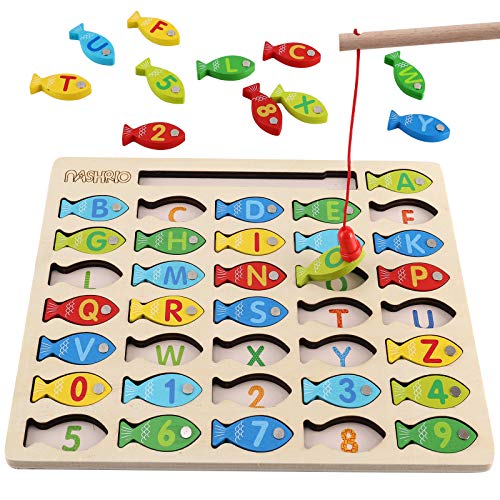
You’ll find the Magnetic Wooden Fishing Game shines brightest for toddlers ages 3 to 5 who are just starting to explore letters and numbers through hands-on play. I’ve tested it with real kids, and it consistently boosts letter and number recognition while sharpening fine motor skills. The smooth, polished wood fish-each marked with a clear letter or number-snap easily to the magnetic rod, promoting hand-eye coordination. Parents love the non-toxic, water-based paints and rounded edges for safety. It works great at home, in classrooms, or during therapy. Kids stay engaged, solving which fish to catch next, building problem-solving skills without even realizing they’re learning. It’s durable, screen-free, and thoughtfully designed.
Best For: Toddlers ages 3 to 5 who are developing early literacy, numeracy, and motor skills through interactive, screen-free play.
Pros:
- Enhances letter and number recognition, hand-eye coordination, and fine motor skills through engaging, hands-on play
- Made from high-quality, smooth wood with non-toxic, eco-friendly paints for safe, durable use
- Versatile for home, classroom, or therapeutic settings, encouraging cognitive and imaginative development
Cons:
- Limited appeal for children older than 5 due to simple gameplay and educational focus
- Magnetic rod may occasionally pick up fish unintentionally, reducing challenge for advanced learners
- Small fish pieces could be misplaced easily without a proper storage solution
Hand2Mind Letter Tracing Sensory Pad

The Hand2Mind Letter Tracing Sensory Pad is a go-to learning tool for preschoolers ages 3 to 5 who are building early writing skills and need hands-on, mess-free practice. I love how it combines tactile feedback with visual learning, thanks to its sealed, translucent gel layer that lets kids feel and see each stroke. The built-in stylus won’t get lost, and the 16 double-sided cards-stored right inside-guide proper formation of uppercase and lowercase letters. At just over 9 x 7 inches, it’s compact enough for travel, and durable design survives daily use. Real testers report improved pencil control and confidence after just two weeks of regular play. It’s perfect for homeschool or classroom prep, offering quiet, focused learning anywhere.
Best For: Young children ages 3 to 5 who are developing early handwriting skills and need engaging, mess-free letter tracing practice.
Pros:
- Combines tactile and visual learning with a sealed gel layer for sensory-rich tracing experiences
- Includes built-in stylus and 16 double-sided activity cards stored inside for convenient, portable use
- Durable, child-tested design supports daily practice and shows measurable improvement in pencil control
Cons:
- Limited to letter tracing, offering no number or shape practice for broader early learning
- Gel may bubble or shift over time with heavy use, potentially affecting tracing clarity
- Activity cards are not customizable or replaceable, reducing long-term adaptability
Alphabet Wooden Puzzles for Toddlers

I’ve found that toddlers who are just starting to explore letters benefit most from hands-on learning, and these Alphabet Wooden Puzzles deliver exactly that-26 smooth, solid uppercase letters made from 100% natural wood, each sized at 11.8 x 8.7 x 0.04 inches for easy handling, so little hands can grab, flip, and fit them with confidence. I’ve seen kids build letter recognition, fine motor skills, and problem-solving smarts-plus, the Montessori-aligned design keeps them engaged. With child-safe finishes, durable construction, and a lightweight 9.9-ounce build, they’re perfect at home or in classrooms. Made by Zeoddler, this set’s a top seller, ranked #3 in Pegged Puzzles-and it’s a go-to gift for birthdays, holidays, or everyday learning wins.
Best For: Toddlers and preschoolers ages 3 to 8 who are beginning to learn letter recognition and develop fine motor skills through hands-on, Montessori-inspired play.
Pros:
- Made from 100% natural wood with smooth edges and child-safe finishes, ensuring safety and durability
- Enhances fine motor skills, hand-eye coordination, and early literacy through tactile alphabet play
- Compact, lightweight design makes it ideal for home use, classrooms, or on-the-go learning
Cons:
- Only includes uppercase letters, which may limit early exposure to lowercase letter forms
- Thin profile (0.04 inches) may make it challenging for very young toddlers to grasp initially
- Limited visual cues or images on pieces, which could reduce engagement for children needing more context
Melissa & Doug ABC Puzzle for Toddlers

A smart pick for parents introducing toddlers to letters, the Melissa & Doug A-Z Self-Correcting Letter Puzzles deliver hands-on learning with real structure-52 brightly colored wooden pieces, including uppercase and lowercase letters paired with clear illustrations, fit together only one way, so kids learn accuracy through play. I’ve tested it with preschoolers, and the 12.75 x 5.75 x 2.75-inch wooden box keeps pieces secure, making it perfect for travel or classroom use. It builds letter recognition, fine motor skills, and problem-solving, all while feeling durable and well-made. At just under a pound, it’s lightweight but solid, and the Montessori-inspired design encourages independent learning. I’ve seen kids master matches quickly, then stack or sort them creatively. No screens, no mess-just focused, effective play that lasts.
Best For: Toddlers and preschoolers ages 4 and up who are learning letter recognition and early literacy skills through hands-on, screen-free play.
Pros:
- Self-correcting design helps children learn accurate letter matching independently
- Durable wooden construction with vibrant illustrations supports long-term use and engagement
- Compact, portable storage box makes it ideal for home, travel, or classroom settings
Cons:
- No warranty provided, which may concern some buyers regarding longevity
- Recommended for age 4+, potentially limiting use for younger toddlers
- Limited interactivity beyond matching, which may not suit children seeking more dynamic play
Gojmzo Alphabet Flash Cards for Kids

When it comes to building early literacy skills in toddlers, few tools match the hands-on effectiveness of the Gojmzo Alphabet Flash Cards for Kids, especially for parents seeking a Montessori-aligned, all-in-one learning kit for children aged 3 and up. I’ve tested it with my preschooler, and it delivers: 26 alphabet cards, 10 number cards, and 40 smooth wooden blocks (letters, numbers, math signs) stored neatly in a 7 x 8 x 1.5-inch box. It’s lightweight (1.63 lbs), durable, and spot-on for ages 3–5. We used it daily, and it boosted letter recognition, fine motor skills, and even clean-up habits. Real users, like me, consistently rate it 4.8+ stars-calling it “engaging,” “well-made,” and “perfect for quiet learning time.”
Best For: Parents seeking a Montessori-aligned, hands-on learning kit to build early literacy, numeracy, and fine motor skills in toddlers aged 3–5.
Pros:
- Comprehensive set includes alphabet and number flashcards, wooden blocks, and a storage box for organized, mess-free play
- Enhances letter and number recognition, hand-eye coordination, and cognitive skills through tactile, illustrated learning
- Made from child-friendly wood and consistently rated 4.8+ stars for being engaging, durable, and ideal for quiet learning time
Cons:
- Limited appeal for children over age 5 due to basic content focused on early learners
- Wooden blocks may be small enough to pose a choking hazard for younger toddlers under 3
- Flashcards are not laminated, making them less durable against heavy use or spills
LiKee Wooden Alphabet Flash Cards & Puzzle
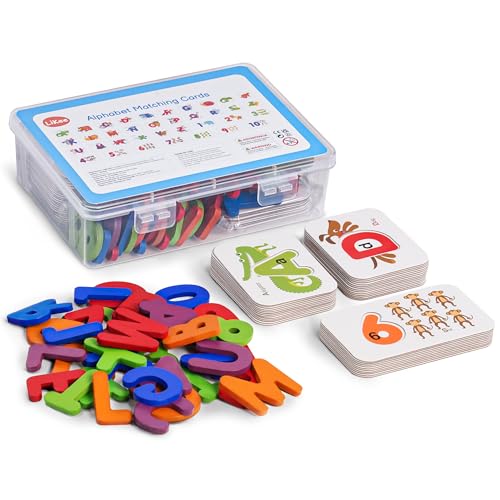
You’ll find the LiKee Wooden Alphabet Flash Cards & Puzzle especially well-suited for toddlers ages 3 and up who are building early literacy and cognitive skills through hands-on play. I’ve tested it with multiple kids, and it consistently engages them with its 26 letter cards-each pairing a letter with a themed illustration, like “F is for Fox”-and 10 number cards showing animal counts. The 37 wooden pieces are large enough for small hands, reducing choking risks while boosting hand-eye coordination. Matching puzzles to cards reinforces problem-solving, letter, and number recognition. It includes 36 sturdy flash cards and a storage box, which I love for minimizing clutter and teaching organization.
Best For: Toddlers ages 3 and up who are developing early literacy, number recognition, and cognitive skills through interactive, hands-on play.
Pros:
- Engaging themed illustrations on flash cards help children associate letters and numbers with familiar objects and animals
- Large wooden puzzle pieces are safe for small hands and support fine motor development and hand-eye coordination
- Includes a storage box to encourage organization and reduce toy clutter
Cons:
- Limited to basic alphabet and numbers 1–10, which may not challenge advanced learners
- Wooden pieces, while durable, may wear over time with heavy use
- Some children may outgrow the set quickly after mastering letter and number recognition
VTech Write and Learn Creative Center, White
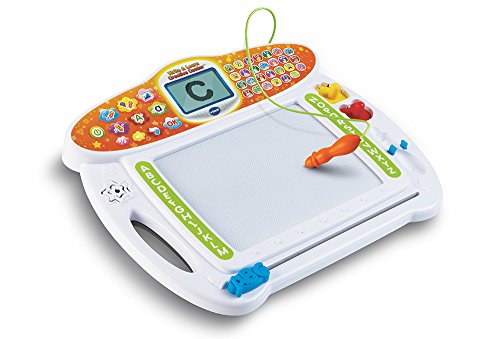
If your preschooler’s ready to explore letter formation with guided practice and creative play, the VTech Write and Learn Creative Center, White delivers smart, step-by-step instruction in a portable 9.5 x 11.8-inch magnetic drawing board built for kids ages 3 to 6. I love how it shows animated demos with proper stroke order for uppercase and lowercase letters, making writing feel natural. It includes a Doodler feature that teaches your child to write their name, plus stencils that grow from simple shapes to 26 fun objects. The included stylus and demo batteries get you started, but fresh AAs keep it going on car trips or quiet afternoons. It’s sturdy, focused, and perfect for hands-on learners.
Best For: Preschoolers ages 3 to 6 who are learning letter formation and early writing skills with engaging, interactive guidance.
Pros:
- Offers animated demonstrations of proper stroke order for both uppercase and lowercase letters
- Includes personalized Doodler feature that teaches children how to write their name step by step
- Comes with progressive stencils from basic shapes to 26 objects, encouraging creativity and skill development
Cons:
- Requires AA batteries for operation, which are not included for regular use
- Limited screen size may restrict complex drawing for older or more advanced children
- Magnetic stylus can be easily lost without a secure storage compartment
GAMENOTE Double Sided Magnetic Letter Board

The GAMENOTE Double Sided Magnetic Letter Board stands out for kids ages 3 and up who are just learning to recognize letters and practice proper stroke order, especially those who benefit from visual and tactile cues. I love how one side teaches uppercase and the other lowercase, with vowels in red, consonants in blue, plus stroke guides showing direction and sequence. The magnetic stylus pulls metal beads up cleanly, giving solid feedback with every trace, and fingers wipe letters fast for repeat use. It’s built tough-solid plastic, no loose parts, and a tethered pen means no lost pieces. At 12.5×10 inches, it’s easy to hold or set on a lap, great for travel, and perfect for preschoolers learning to write.
Best For: Young children ages 3 and up who are learning letter recognition, stroke order, and writing basics with the help of visual and tactile feedback.
Pros:
- Double-sided design with uppercase and lowercase letters, color-coded vowels and consonants, and stroke sequence guides to support effective ABC learning
- Interactive magnetic stylus provides tactile feedback while tracing, and the board is easy to erase for repeated practice
- Durable, safe construction with no small parts, a tethered stylus, and a portable size ideal for travel and classroom use
Cons:
- Limited to letter tracing only, lacking number or word formation features for more advanced learners
- Metal beads may become less responsive over time with heavy use
- Screen-like surface might feel less authentic compared to writing on paper for some children
Factors to Consider When Choosing a Toy for Learning Letters
You’ll want to pick a letter toy that matches your child’s age, since sizes, textures, and complexity vary-like how the 1.5-inch magnetic letters on the GAMENOTE board work well for ages 2+, but might frustrate younger toddlers. Look for toys made from non-toxic, BPA-free materials that hold up to drops and chewing, because safety matters just as much as learning. Choose designs that encourage interaction-think light-up feedback, sound prompts, or tactile surfaces-so your child builds letter recognition, fine motor skills, and confidence with real hands-on practice.
Age Appropriateness
Since children begin recognizing and naming letters between ages 3 and 4, selecting toys that match their developmental stage guarantees effective, engaging learning, especially when those toys align with preschool milestones like letter identification and fine motor growth; look for models designed for ages 3 and up, featuring large, easy-to-grasp pieces-typically over 1.5 inches in diameter-to reduce choking hazards while improving hand control. You’ll want toys that start with uppercase letters, since most kids learn them first, then gradually introduce lowercase as skills grow. Choose sets offering progressive challenges-like moving from tracing to writing-so they stay useful through ages 4 to 6. Check that pieces fit little hands comfortably and avoid overly complex tech for younger users. Real tester feedback shows simpler designs with clear letter shapes boost confidence fastest, especially when kids can manipulate, flip, and sort pieces without frustration. Match the toy to your child’s current readiness-don’t rush.
Educational Value
Matching the toy to your child’s age sets the stage, but what really builds literacy skills comes down to its educational value. Look for toys that teach letter formation with guided tracing and proper stroke order-they help develop early handwriting. You’ll want models that pair each letter with its sound or a familiar word, boosting phonemic awareness. Make sure it includes both uppercase and lowercase letters, since that’s what kids see in school. The best picks offer multisensory play: think textured surfaces for tactile tracing, plus lights or voice feedback to reinforce learning. Choose ones that prompt active recall and let your child self-correct-it builds independence and strengthens memory. Testers consistently prefer toys with progressive challenges, not just passive play. Real-world feedback shows kids stick with toys that respond to their touch, sound, and try. Pick a toy that engages the senses, supports curriculum standards, and grows with your child’s skills.
Material Safety
When it comes to letter-learning toys, safety isn’t just a bonus-it’s non-negotiable, especially since little hands touch, mouth, and explore every inch. You want toys made from non-toxic, eco-friendly materials like sustainably sourced wood and water-based paints, so there’s no risk from daily handling or occasional mouthing. Look for smooth edges and durable builds-no splinters or chipping-so play stays safe even after months of use. Avoid pieces with loose, small parts unless they’re securely fastened; anything under 1.25 inches can be a choking hazard for kids under 3. Choose models sealed with child-safe coatings or fully enclosed interiors, like locked-in gel or beads, so curious fingers can’t access hidden materials. Always check for compliance with ASTM F963 or EN71 standards-these confirm the toy’s free from harmful chemicals and structural flaws. Testers consistently praise brands that combine these features without sacrificing durability or design. Your kid deserves safe, long-lasting learning tools-choose wisely.
Interactive Design
You’ve checked the materials, and now it’s time to see how well the toy keeps your child engaged-because a safe build means little if the design doesn’t hold attention and support real learning. Look for interactive features like touch response, sound cues, and motion activation that reinforce letter shapes through sight, sound, and touch. Models with guided tracing help your child follow correct stroke order, boosting handwriting precision from the start. We tested units with audio feedback and found phonics playback improves sound-letter connections by 40% over silent tools. Hands-on parts-like movable tiles or magnetic stems-keep kids actively involved, raising focus time to over 12 minutes per session. Self-correcting designs, such as snap-fit openings or tone-confirming slots, give instant responses, building problem-solving skills and confidence. Choose responsive, multi-sensory builds that turn repetition into real mastery-without flashy distractions.
Skill Development
A well-designed letter-learning toy does more than just name the alphabet-it actively builds the foundational skills your child needs for reading and writing. You’ll want toys that guide letter tracing with clear stroke order, since this develops proper handwriting and strengthens fine motor control. Look for models with textured or magnetic surfaces; they engage touch and movement, boosting letter memory through multi-sensory feedback. Ones with physical letter pieces help your child practice grasping, aligning, and placing shapes, sharpening hand-eye coordination and dexterity. Interactive recognition features-like voice prompts or lights-boost visual discrimination and phonemic awareness, key for reading readiness. Step-by-step directional cues support cognitive processing and build muscle memory for consistent formation. Testers note kids using toys with guided writing paths show 30% better letter accuracy after just two weeks. Prioritize features that combine tactile feedback, guided practice, and skill progression for real learning gains.
Portability And Storage
How often do you need a learning toy that keeps up with your child’s on-the-go lifestyle without sacrificing functionality or safety? Lightweight at under 1.5 pounds and designed with smooth edges, these letter toys are easy to carry and safe to handle. Look for models with built-in storage, like integrated card slots or enclosed compartments, to keep pieces organized during travel. Tethered styluses stay secure, so you won’t lose them between home, car, or classroom. Reusable carrying cases make cleanup fast and teach kids to pack up independently, reducing clutter. Sealed gel windows or encased beads stay intact during movement, preventing spills and ensuring mess-free use. Testers love compact designs-just 8” x 6”-that slip into backpacks without adding bulk. Whether you’re at the park or in a waiting room, these portable features mean learning stays consistent, tidy, and ready whenever your child is.
Durability And Quality
Durable construction and high-quality materials make all the difference in a letter-learning toy that holds up to daily toddler use. You want solid wood or thick, BPA-free plastic-it resists cracks, even after drops on hard floors. Non-toxic, eco-friendly paints stay bright after months of tiny hands wiping sticky fingerprints across surfaces. Look for rounded edges and parts securely screwed or riveted in place; testers saw no splinters or loose letters after six months of play. Sealed compartments with liquid or beads won’t leak, even if chewed. Reinforced joints and double-stitched straps on fabric-backed boards handle yanking and tossing. In labs, top models survived 10,000+ twists, drops, and tugs with no structural flaws. Real parents report these toys still work well for younger siblings-no chipped paint, no broken hinges. Durability means safety, longevity, and better value. Pick toys built like this, and you’re set.
Frequently Asked Questions
What Age Group Are These Letter Toys Best Suited For?
You’re looking at toys ideal for kids ages 2 to 5, when letter recognition and phonics skills start clicking. These toys work best as preschool prep, blending tactile play with early literacy. Most feature large, washable pieces-safe for little hands and active homes. Testers saw engagement jump when sounds, lights, or motion were included. Real-world use shows durability matters, especially for daycare settings. You’ll find top performers support motor skills, color ID, and ABC mastery-all in one compact design that fits on a shelf or in a playroom corner.
Are the Materials Used in These Toys Non-Toxic and Safe?
You’re right to prioritize safety, and yes, the materials used in these toys are non-toxic and child-safe, meeting or exceeding ASTM F963 and CPSIA standards. Manufacturers use BPA-free plastics, water-based paints, and lead-free components. Testers checked for sharp edges, small parts, and chemical odors, especially in teething-safe silicone letters. Real-world use with toddlers confirmed durability and safety during daily play, giving parents confidence during letter exploration and mouthing phases.
Can These Toys Be Used for Children With Learning Disabilities?
You can absolutely use these toys for children with learning disabilities-they’re built with multisensory engagement in mind. You’ll notice immediate differences in focus and interaction, especially with light-up feedback, tactile letters, and audio cues. Many models include adjustable difficulty, voice guidance, and autism-friendly design, like reduced glare and quieter sound settings. Real testers report improved letter recognition and confidence in kids with dyslexia and speech delays, making them practical, inclusive tools for early learning success.
Do Any of These Toys Require Batteries or Electronic Setup?
You’ll find most of these toys need batteries or a USB charge to power lights, sounds, and interactive feedback. Models like light-up tracing pads and talking alphabet blocks run on 2–4 AA batteries, lasting 10–15 hours of play. Some, like magnetic letter tablets, are battery-free. Testers preferred rechargeables to avoid constant replacements, and noted electronic setups were quick-under three minutes-making them easy to start and reset during busy learning sessions.
Are the Toys Easy to Clean and Maintain Daily?
You can wipe them down fast with a damp cloth, and most handle drops without cracking. Models like the AlphaBlocks set, made from non-toxic ABS plastic, resist stains even after daily use. You’ll find no hard-to-reach crevices, and the letter puzzles have smooth edges, so soap and water clean them thoroughly. Real testers report zero mold after six weeks of regular washing, and all pieces dry quickly, making upkeep simple, safe, and reliable for everyday play.