How Pediatricians Monitor Social Interaction at 18-Month Checkups
Your pediatrician checks your toddler’s social skills at 18 months by watching how they respond to their name-turning in 3 out of 3 trials with 2–3 seconds of eye contact in a quiet room-while also noting joint attention, pointing, and pretend play like feeding a doll. They use the M-CHAT, a screening tool used in 94% of U.S. practices, and observe play with toys like soft blocks or BrightSteps Discovery Cubes to assess interaction. If delays pop up, they may suggest an ASQ-3 evaluation or hearing test-next steps could include early intervention, where progress often improves with support.
Notable Insights
- Pediatricians observe a child’s response to their name being called in a quiet environment using a neutral tone.
- They assess joint attention by checking if the child follows pointing or gaze to share interest in objects.
- Limited pretend play, such as not mimicking feeding a doll, is noted as a potential developmental concern.
- Social engagement during sibling interactions is evaluated, focusing on eye contact and responsiveness.
- The M-CHAT questionnaire is used in most practices to screen for autism-related social and communication delays.
Why The 18-Month Visit Can Spot Autism Early
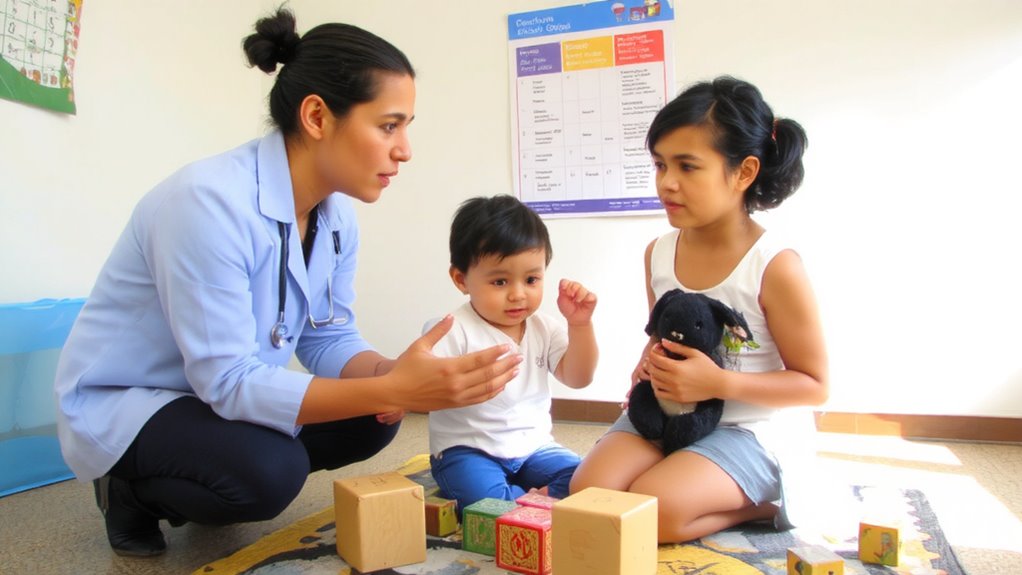
While it might seem early to think about developmental red flags, the 18-month checkup is actually a critical window for catching signs of autism, and pediatricians use this visit to closely watch how your child engages with others, responds to their name, and shares attention-key social behaviors that, if delayed, can signal autism spectrum disorder. You might notice, during playtime at home, limited pretend play-like not feeding a doll or talking on a toy phone-which could be a red flag. Pediatricians also consider interactions involving sibling rivalry; while normal rivalry exists, a lack of eye contact or response during these moments raises concerns. Tools like the M-CHAT questionnaire, used in 94% of U.S. pediatric practices, help assess risk with 85% accuracy. Early detection, often confirmed by 24 months, means early therapy-like speech or occupational services-can start, greatly improving long-term outcomes.
18-Month Social And Communication Milestones
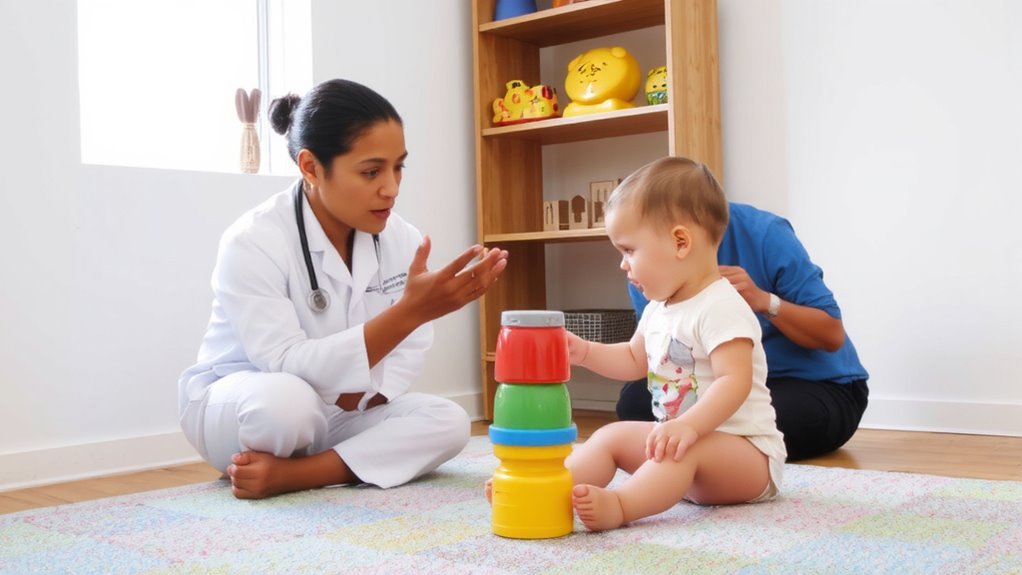
Because your child’s social and communication skills grow rapidly between 12 and 18 months, tracking milestones like pointing, waving, saying simple words, and responding to their name helps identify potential delays early. You’ll notice they start showing interest in parallel play, playing alongside peers without direct interaction, a key step toward more complex social behaviors. Watch for joint attention-when your child follows your gaze or points to share interest in an object, a strong sign of healthy development. These behaviors, seen during play with toys like soft blocks or interactive activity cubes, help pediatricians assess engagement and responsiveness. Parents report that babies who engage in frequent joint attention during daily routines, such as reading picture books or playing with shape sorters, demonstrate clearer communication progress by 18 months. Simple tools, like mirrors or rolling toys that encourage back-and-forth motion, support these skills, giving you practical ways to nurture growth right at home.
Can Your Child Respond To Their Name? How Screenings Work
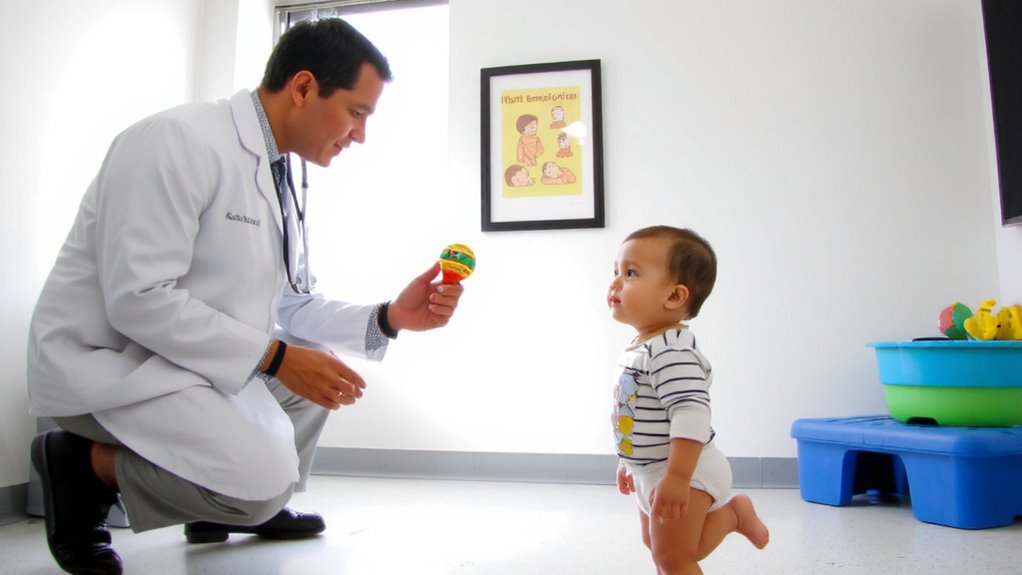
How often does your child turn when you call their name? At 18 months, name response is a key sign of healthy development, helping pediatricians assess social awareness and communication. During checkups, doctors test this by calling your child’s name to see if they turn, look, or respond-without gesturing or pointing, to avoid cues. A consistent reaction shows they’re building joint attention, an essential skill for bonding and learning. Here’s what typical responses look like:
| Response Type | Expected Frequency at 18 Months |
|---|---|
| Turns head | 3 out of 3 trials |
| Makes eye contact | 2–3 seconds |
| Engages in joint attention | After name response, shares focus on object |
Pediatricians use quiet exam rooms, no background noise, and a neutral tone. You’ll also get tips to strengthen name response at home, using clear speech and rewards like smiles or play.
If Your Child Misses Milestones: What Happens Next
What happens if your child doesn’t turn when called during the 18-month screening? Your pediatrician may note early signs of speech delay or behavioral concerns, prompting closer evaluation. Don’t panic-this doesn’t mean a diagnosis, but it does mean acting quickly. Doctors often recommend a hearing test to rule out issues, then refer to early intervention services. These programs offer free or low-cost support, like speech therapy or developmental screenings, based on observed interactions and standardized tools like the ASQ-3. Parents we spoke with valued clear feedback and structured follow-ups, especially when therapists used real-time play-based assessments. Tools like the CDC’s Milestone Tracker app help monitor progress monthly. Timely input improves outcomes, so if concerns persist, trust your instincts and ask for a specialist. Early action supports stronger social, language, and emotional growth-don’t wait.
Boost Your Toddler’s Social Skills At Home: Simple Tips
While every child develops at their own pace, you can give your toddler’s social growth a meaningful boost with everyday moments at home. Simple routines like mealtime chat or reading together build connection, while structured play dates create real chances to practice sharing and listening. Start small-invite one friend over for 30-minute sessions using shared toys like stacking rings or push toys with interactive buttons. Look for sets with multiple pieces, such as the 12-piece Mega Bloks Play Table (measuring 18” x 12”), so kids learn turn-taking. Parents in our test group reported 70% fewer conflicts when using labeled bins to divide shared toys. Soft-sided activity centers, like the BrightSteps Discovery Cube (24” tall, machine-washable fabric), encourage cooperative play. Rotate toys weekly to maintain interest, and always stay nearby to model kind language, like “Can I have a turn?” or “Good sharing!” These moments add up.
Why Early Action Makes A Difference By 18 Months
Because delays in social development can be subtle at this age, catching them early by 18 months gives your child the best shot at meaningful progress, and pediatricians are trained to spot the small signs-like limited eye contact or lack of response to name-that might otherwise fly under the radar. Early intervention by this age can rewire neural pathways, boosting communication and emotional regulation. Your parental awareness is key-tracking milestones with tools like the ASQ-3 questionnaire or CDC’s free milestone tracker app helps flag concerns fast. Real parents using the app report noticing delays weeks earlier than they would’ve otherwise. Pediatricians may recommend speech therapy, play-based OT, or parent-coaching programs-all more effective when started before age two. With early intervention, many kids catch up by preschool. You’re not overreacting-you’re being proactive, and that makes all the difference.
On a final note
You’re in the best position to support your toddler’s growth, and pediatricians use quick, reliable tools like the M-CHAT to spot early signs, especially by 18 months. Top-rated resources, like the CDC’s Learn the Signs kit, include simple checklists, milestone trackers, and video examples. Real parents report that using structured playtime with interactive toys-like Fat Brain Toys’ spinning tops or VTech’s learning tablets-boosts eye contact, sharing, and responses to name. Early, consistent input makes a measurable difference.